
Background
The North-West University Water Research Group (WRG) is an interdisciplinary research group within the Unit for Environmental Sciences and Management (UESM) and the School of Biological Sciences at the North-West University (NWU), Potchefstroom Campus. Established in 2012, the WRG has grown into one of Africa's leading aquatic science research groups, recognised internationally for its contributions to aquatic ecology, ecotoxicology, parasitology and biodiversity science.
The WRG advances the science required to understand, protect and restore healthy aquatic ecosystems through internationally recognised research in ecology, ecotoxicology and parasitology. By integrating these complementary disciplines, the group investigates how biodiversity, environmental change and human activities influence the health and resilience of freshwater, estuarine and marine ecosystems. This interdisciplinary approach enables the WRG to address complex environmental challenges ranging from biodiversity conservation and sustainable water-resource management to pollution, ecosystem health, emerging diseases and One Health.
The group was founded by Professors Nico Smit and Victor Wepener, together with Dr Gordon O'Brien, and has expanded into a multidisciplinary team comprising internationally recognised researchers with expertise in aquatic ecology, ecotoxicology, biodiversity science, environmental risk assessment, conservation biology, fish biology and parasitology. Today, the core research team consists of Prof Nico Smit, Prof Victor Wepener, Associate Prof Wynand Malherbe, Associate Prof Kerry Hadfield-Malherbe, Associate Prof Courtney Cook and Senior Project Manager Adri Joubert. Together they lead an extensive network of postgraduate students, postdoctoral fellows, extraordinary appointees and collaborators from universities, research institutions and government agencies across Africa, Europe, Asia, Australia and the Americas.
Since its establishment, the WRG has developed a truly international research programme, conducting research throughout South Africa and across southern Africa, while maintaining active collaborations on projects spanning Europe, Asia, North and South America and Australia. Through long-term partnerships with government departments, conservation agencies, industry and international universities, the group combines fundamental scientific discovery with applied research that informs environmental policy, biodiversity conservation and sustainable resource management.
The WRG is home to internationally recognised research infrastructure, including the National Aquatic Bioassay Facility (NABF)—one of the largest zebrafish ecotoxicology facilities in the Southern Hemisphere—as well as specialised molecular, microscopy and field research facilities that support cutting-edge aquatic science. The group also pioneers innovative international Living Laboratories, using South Africa's unique aquatic ecosystems as platforms for research, postgraduate training and international scientific collaboration.
Today, the WRG is recognised not only for scientific excellence but also for developing future scientific leaders, building international research partnerships and translating science into meaningful societal impact. Through its integrated research programme, the group contributes to biodiversity conservation, environmental governance, water security, ecosystem restoration and the sustainable management of aquatic resources across Africa and beyond.
Vision
To be an internationally recognised leader in aquatic science, generating the knowledge required to understand, protect and restore healthy aquatic ecosystems through innovative, interdisciplinary research, international collaboration and scientific excellence.
Mission
The mission of the Water Research Group is to advance scientific understanding of aquatic ecosystems through integrated research in ecology, ecotoxicology and parasitology while translating this knowledge into solutions for biodiversity conservation, environmental management and sustainable development.
Specifically, the WRG strives to:
- Advance the understanding of freshwater, estuarine and marine ecosystem structure, functioning and resilience.
- Generate knowledge on biodiversity, systematics, ecology and conservation, with particular emphasis on aquatic organisms and their parasites.
- Assess the effects of environmental stressors, pollutants and emerging contaminants on aquatic organisms and ecosystem health.
- Develop science-based tools and approaches for environmental risk assessment, ecosystem management and water-resource conservation.
- Promote One Health by investigating the interactions between biodiversity, ecosystem health and disease.
- Train the next generation of aquatic scientists through high-quality postgraduate education, international collaboration and experiential learning.
- Translate scientific knowledge into evidence that supports environmental policy, conservation practice and sustainable resource management.
Research focus areas
The Water Research Group has three main focus areas, supported by interdisciplinary aspects:
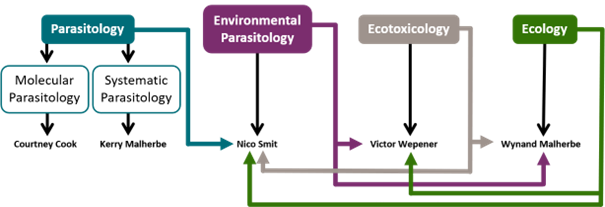
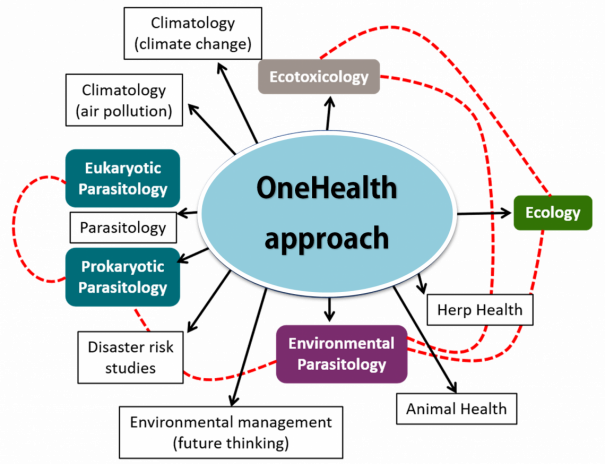
In addition, we aim to connect the dots within other aspects of the OneHealth concept through collaborations with local, national and international research groups:
Last updated: June 2026
Comments on the content and accessibility, please contact: Adri Joubert