
Solar Physics is the study of the Sun as an active star and as the driver of the space environment around Earth. It focuses on the physical processes that shape the solar atmosphere, including magnetic fields, sunspots, prominences, flares, filaments, and eruptions, as well as the way in which solar activity influences the heliosphere and space weather. Because the Sun is the only star that can be observed in such fine detail, solar physics offers a unique opportunity to investigate fundamental plasma and magnetic processes that operate throughout the universe.
Researchers and students in Solar Physics at the Centre for Space Research are interested in understanding how solar activity develops across different layers of the solar atmosphere, from the photosphere to the chromosphere and corona. This includes studying the magnetic structure of active regions, the build-up and release of energy in solar flares, the evolution of filaments and prominences, and the links between solar surface activity and conditions in near-Earth space. Solar Physics therefore stands at the intersection of astrophysics, plasma physics, magnetohydrodynamics, and space science.
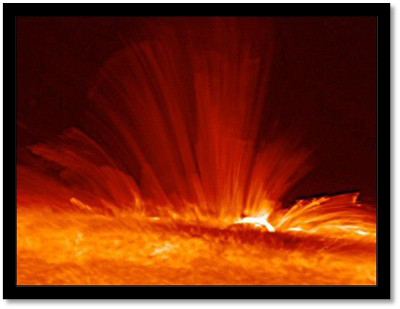
A major strength of Solar Physics at NWU is the combination of observational research, data analysis, and student training. Students are exposed to modern solar datasets from both ground-based and space-based instruments and gain experience in the interpretation of real solar observations. This creates opportunities to develop skills in image analysis, spectroscopy, magnetic field diagnostics, time-series analysis, and computational methods that are valuable both in research and in the broader scientific and technical environment.
NWU has its own solar observing capability through the NWU Solar Telescope Observatory, which provides an important platform for routine solar observations, student development, and public engagement. In addition, our work is strengthened by access to high-quality international datasets, including observations from the Swedish 1-m Solar Telescope (SST), one of the world’s leading facilities for high-resolution solar physics. This means that students interested in Solar Physics at NWU can be part of research that combines local observational capacity with world-class international solar data.
Solar Physics at NWU is further strengthened through collaboration with Northumbria University in the United Kingdom. This collaboration supports scientific exchange, research development, and advanced student opportunities in solar and space physics. Through such international partnerships, postgraduate students can become part of a broader research network while working on topics that are scientifically current, internationally relevant, and well connected to global developments in solar physics.
Interested in studying the Sun?
Prospective postgraduate students are invited to enquire about research opportunities in Solar Physics at NWU. This is an exciting field that combines cutting-edge observations, rich physical theory, and direct relevance to space weather and the Sun-Earth system. Students joining this area can expect to work with real solar data, develop advanced analytical skills, and become part of a growing research environment with both local and international connections.