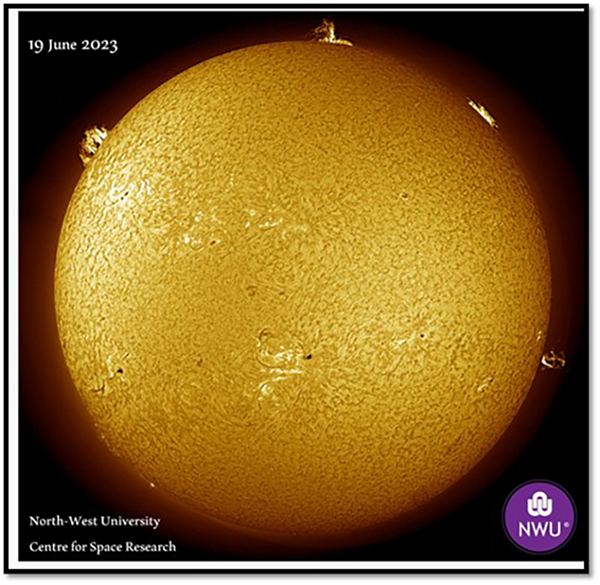
The NWU Solar Telescope Observatory is a ground-based solar observing facility of the North-West University. The facility supports solar observations for research, student training, and public engagement, and forms part of the Centre’s growing activities in solar physics. Its purpose is to provide routine observations of the Sun and to create scientifically useful datasets that can be used for both local projects and broader collaborations.
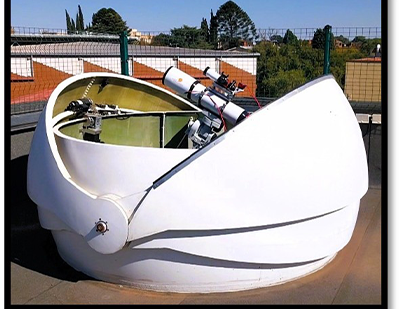
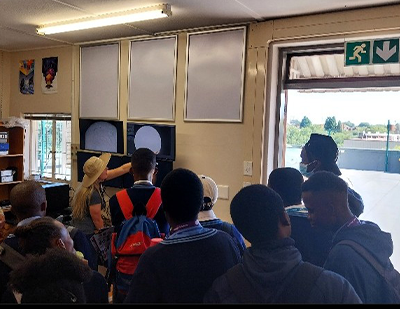
The solar telescope facility enables the study of visible solar features such as sunspots, prominences, filaments, active regions and solar flares. Because the Sun is the nearest star, it can be observed in exceptional detail, allowing students and researchers to investigate how magnetic activity develops on the solar surface and through the solar atmosphere. These observations contribute to a better understanding of solar variability and of the processes that drive space weather and influence the near-Earth environment.
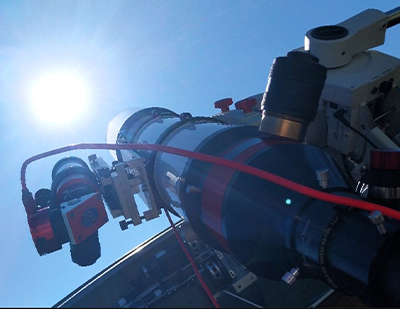
The facility includes dedicated hydrogen-alpha telescopes as well as white-light telescopes, allowing different aspects of solar activity to be observed. The NWU Solar Telescope Observatory was commissioned in 2022 and is used for daily solar observations. These instruments create opportunities for student projects, postgraduate training, and the routine monitoring of solar activity in South Africa.
A key strength of the facility is that it combines research, training and outreach in one platform. Students gain hands-on experience with solar observations, data handling and interpretation, while the facility also supports public-facing activities such as livestreams and astronomy engagement events. In this way, the solar telescope facility serves not only as a research instrument, but also as a gateway through which students and the public can engage directly with modern solar physics.
Public solar data are available through NWU’s public data repository: https://fskbhe1.svcp.nwu.ac.za/solarobs/